 Florian Ledoux
The framework
Deep Ecological Psychology
Deep Ecological Psychology is a framework for reclaiming and strengthening adaptive capacity.
Adaptive capacity is understood as the ability to maintain contact, mobility and orientation in meeting life's challenges.
Foundation
Evolution, deep ecology and neuroscience form the foundation
Evolution
The body, senses and nervous system have been shaped over long spans of time in interaction with landscape, light, climate and relationships. The nervous system has been shaped to read concrete signals in the environment and organize the body's responses accordingly. When the body meets conditions it is biologically attuned to, regulation and direction can emerge with less inner friction. Modern living conditions differ in several ways from the environments in which humans evolved, and this mismatch can make regulation more demanding, so that meeting stress becomes an important part of self-development.
Deep ecology
Arne Næss described the human being as part of a larger living whole, where all life holds value in itself and takes part in mutually dependent processes. The self widens through identification with the living, what Næss called the ecological self. Deep Ecological Psychology builds on this, understanding belonging to this whole as a foundation for health. The body's capacity to find calm, direction and coherence is understood as something that develops in interaction with living surroundings.
Neuroscience
The nervous system continuously registers signals of safety and threat, often before we are aware of them, and organizes the body's responses accordingly. Light, sound, space and landscape are among the signals it reads. Because survival comes first, danger tends to be read a little too quickly and safety a little too slowly, so safety needs time to be recognized. When the nervous system recognizes its surroundings as safe, the body gains greater access to calm, and it becomes easier to move between activation and rest and to find the way back to regulated presence. Research on time in nature and stress recovery points in the same direction. Nature and light can therefore be of real use in self-development, where moving between what brings calm and what brings stress is central to developing the capacity to stay anchored.
Together, these perspectives form the basis for the framework's understanding of adaptive capacity, as the ability to maintain contact, mobility and orientation. This involves the capacity to move between inner states and to remain in anchored and conscious presence.
A distinct standpoint
Related to ecopsychology, with its centre of gravity elsewhere
Deep Ecological Psychology is closely related to ecopsychology. Both draw heavily on Arne Næss, and both start from the recognition that humans belong in nature.
Ecopsychology has chiefly developed this as understanding, of identity and belonging, and of how the ecological crisis of our time is also a psychological one. When the pace and stress of society push people away from nature and belonging over time, time spent in nature can act as a counterforce, and research on nature, stress and attention supports this. Nature therapy and wilderness therapy have taken nature into use as a setting for treatment, most often in groups and with a therapist present.
Deep Ecological Psychology makes this concrete in a body-oriented, listening-based approach. Næss's ecological self is understood here as something that can be experienced directly, through a nervous system that continuously regulates in interaction with the landscape. Belonging to nature and light is therefore given the same place in this understanding as belonging to other people. Landscape and relationships stand side by side as sources of regulation and development, and both are regarded here as fundamental to health.
In Soulcrafting, this is made concrete. The exercises are done outdoors, with open eyes and the gaze toward the landscape, so that nature becomes what the nervous system orients by and regulates through. Original nature is the standpoint to return to, and disturbed nature, such as power lines, roads and dams, becomes an example of what one practises holding in small doses. In this way, Næss's thought on the intrinsic value of nature can also be felt in the body, in the difference between the original and the disturbed. Nature is used to regulate and to anchor.
The framework is psychological and secular, and has no spiritual aim. It describes conditions for regulation and anchoring grounded in evolution, deep ecology and neuroscience, rather than spiritual or religious truths.
 Florian Ledoux
Maps
Four maps of lived experience
The maps present the framework as lived experience. They make visible how contact emerges and narrows, how mobility enables flexibility, and how orientation sustains direction, intention and values. The maps are models, simplifications that make experience easier to recognize and put into words.
The Cradle of Deep Time
An evolutionary perspective on adaptive capacity
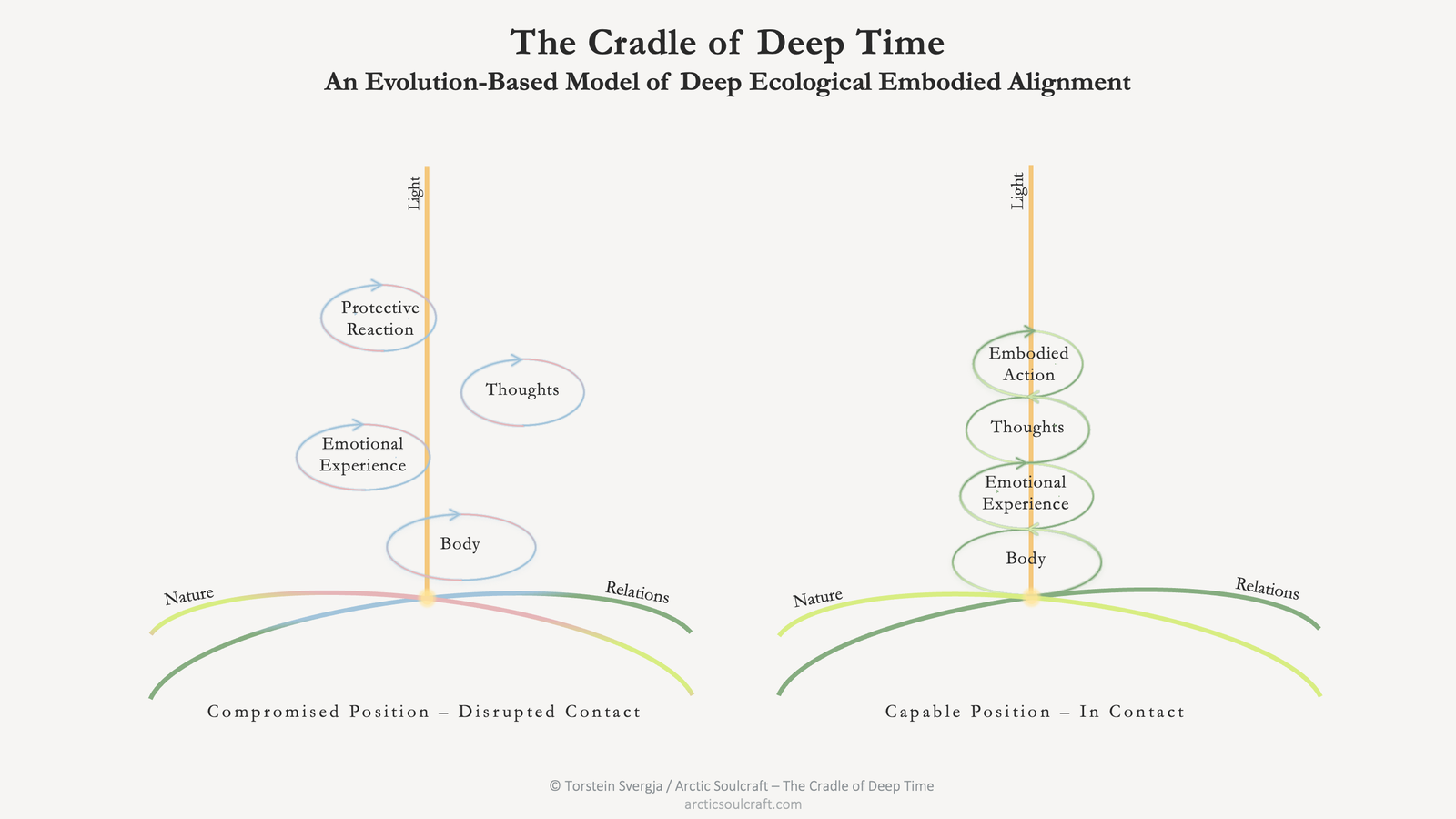
Life can emerge when fundamental conditions act together. In the early development of the Earth, life arose in bounded and protected environments with access to nutrients, exchange between living systems, and, in time, energy through light. Nature, Relations and Light thus formed the basis for the further development of life, and are assumed to give the nervous system a sense of recognition and belonging.
The Cradle of Deep Time points back to this elemental pattern. It shows how human functioning organizes differently depending on whether contact with Nature, Relations and Light is maintained or weakened.
 Florian Ledoux
Tides
A deep ecological model showing shifts in human experience
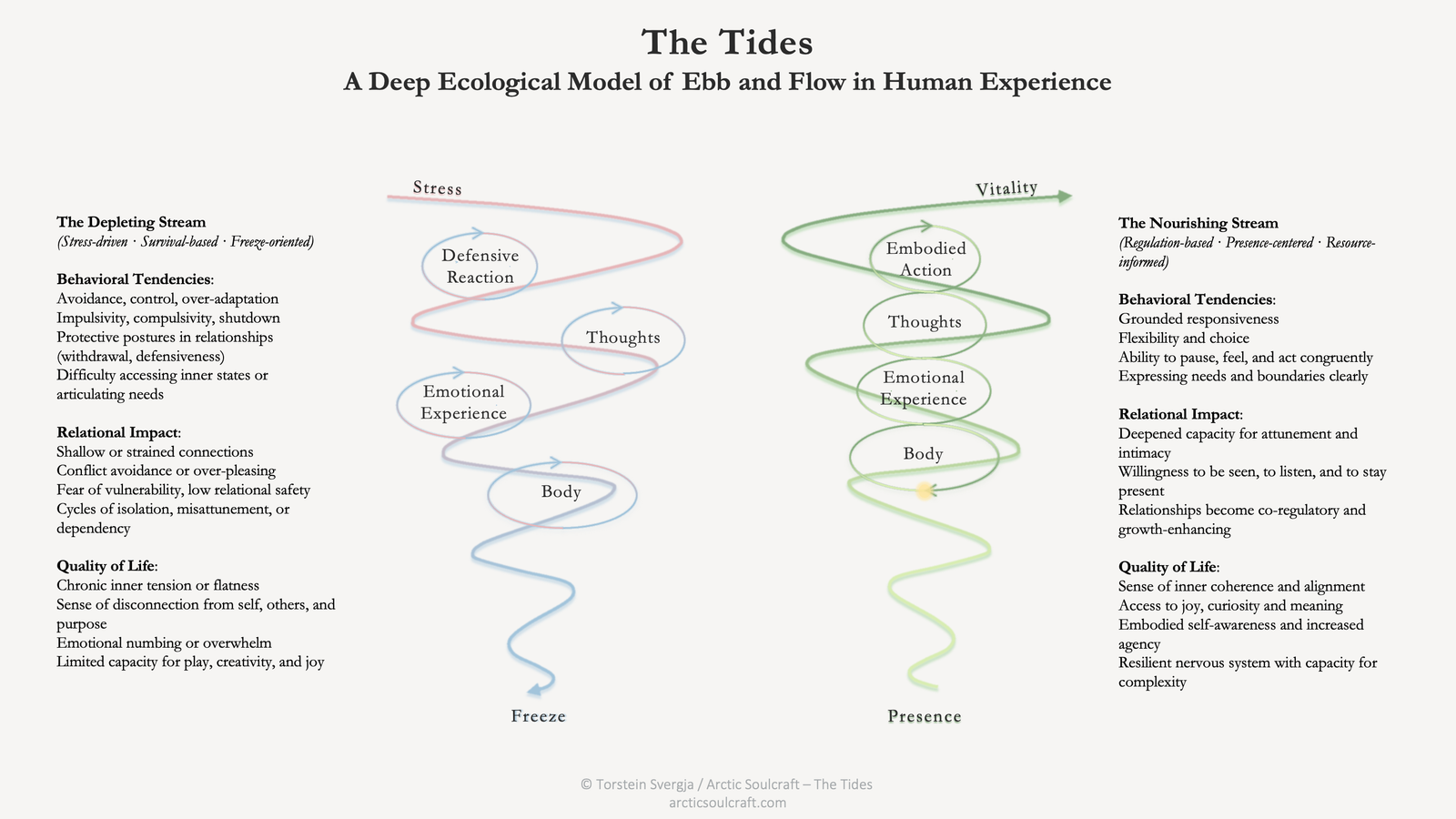
Tides are based on how nature moves between phases of opening and closing. These shifts occur through changes in light, temperature and access to nourishment, and all life is adapted to them. In human experience, similar shifts occur, accelerated by urbanization and relational conditions.
Tides make visible how experience shifts in the meeting between the individual and their surroundings. The model describes two experiential streams, a nourishing stream where contact is maintained, and a depleting stream where contact is weakened. It shows how we move both within and between these two streams.
 Florian Ledoux
The North Star
A map for liberated navigation and sustained inner mobility
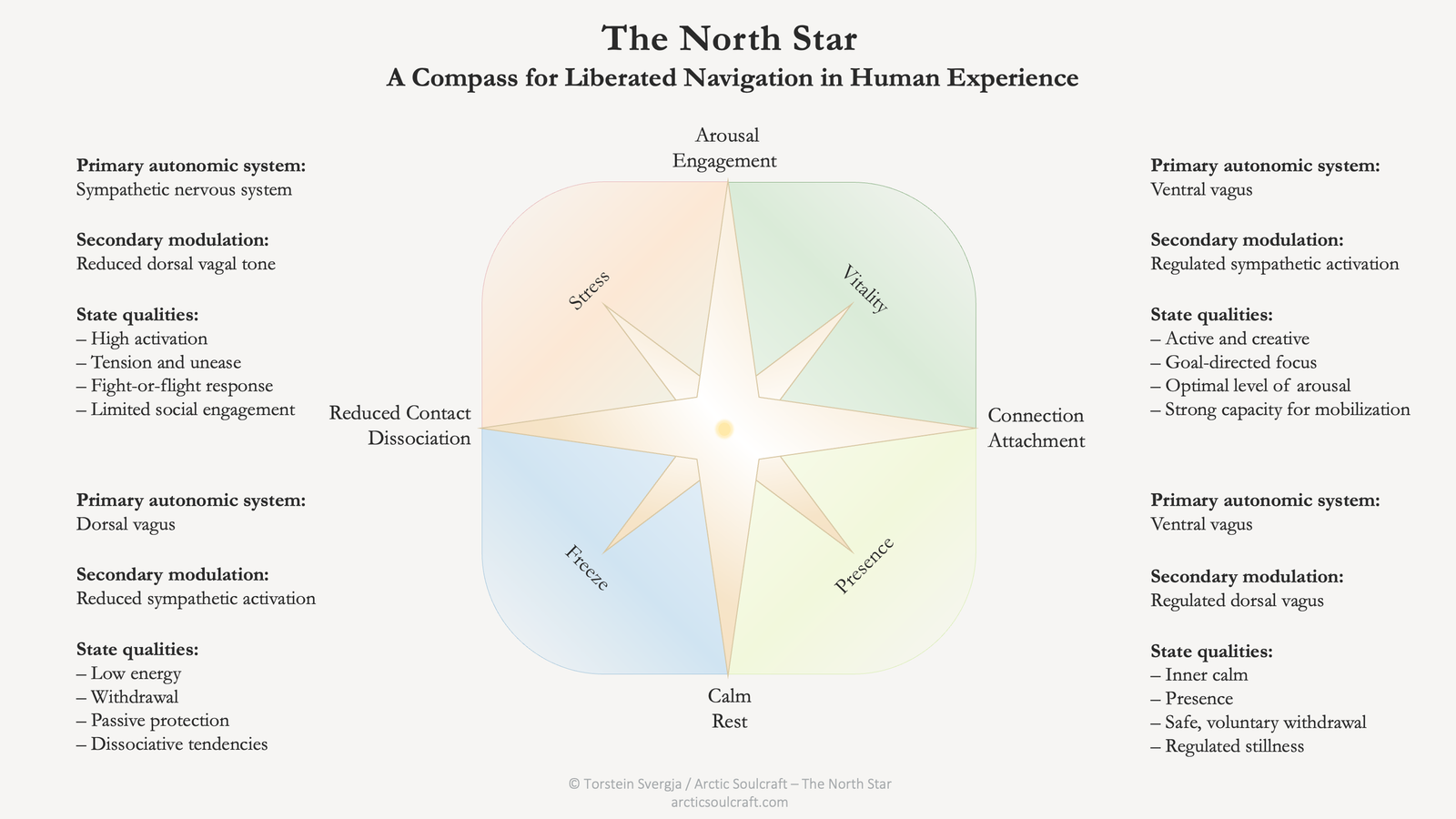
The North Star shows how autonomic patterns in the nervous system give rise to experiences of stress, freeze, presence and vitality. The idea behind the model is that contact is established and anchored in the centre, and that flexibility means being able to move out toward the edges, toward both high activation and shutdown, without losing this anchoring.
The model shows how movement between states allows the nervous system to return to an organization where activation and rest are held within contact. The North Star thus provides a concrete map for understanding where experience is situated, and what kind of movement may help restore and strengthen adaptive capacity.
Arctic Soulcraft guides a journey of self-development that begins with a choice to place oneself at the centre of the model. This means choosing the nourishing stream of experience as one's standpoint, and from there meeting challenges in ways that open and create contact.
Breathing Space is made to make this choice visible. The Bridge program is a concrete guide in choosing between ways of meeting challenges that open and ways that close. Soulcrafting is a deepened practice of widening flexibility and the capacity to stay anchored across circumstances.
In this way, the North Star becomes an arena for a spiral movement from the centre out toward the edges. The capacity to visit the edges without losing anchoring in the centre becomes the ultimate aim of self-development.
 Florian Ledoux
EbAM
A three-dimensional framework for anchoring, alignment and integration
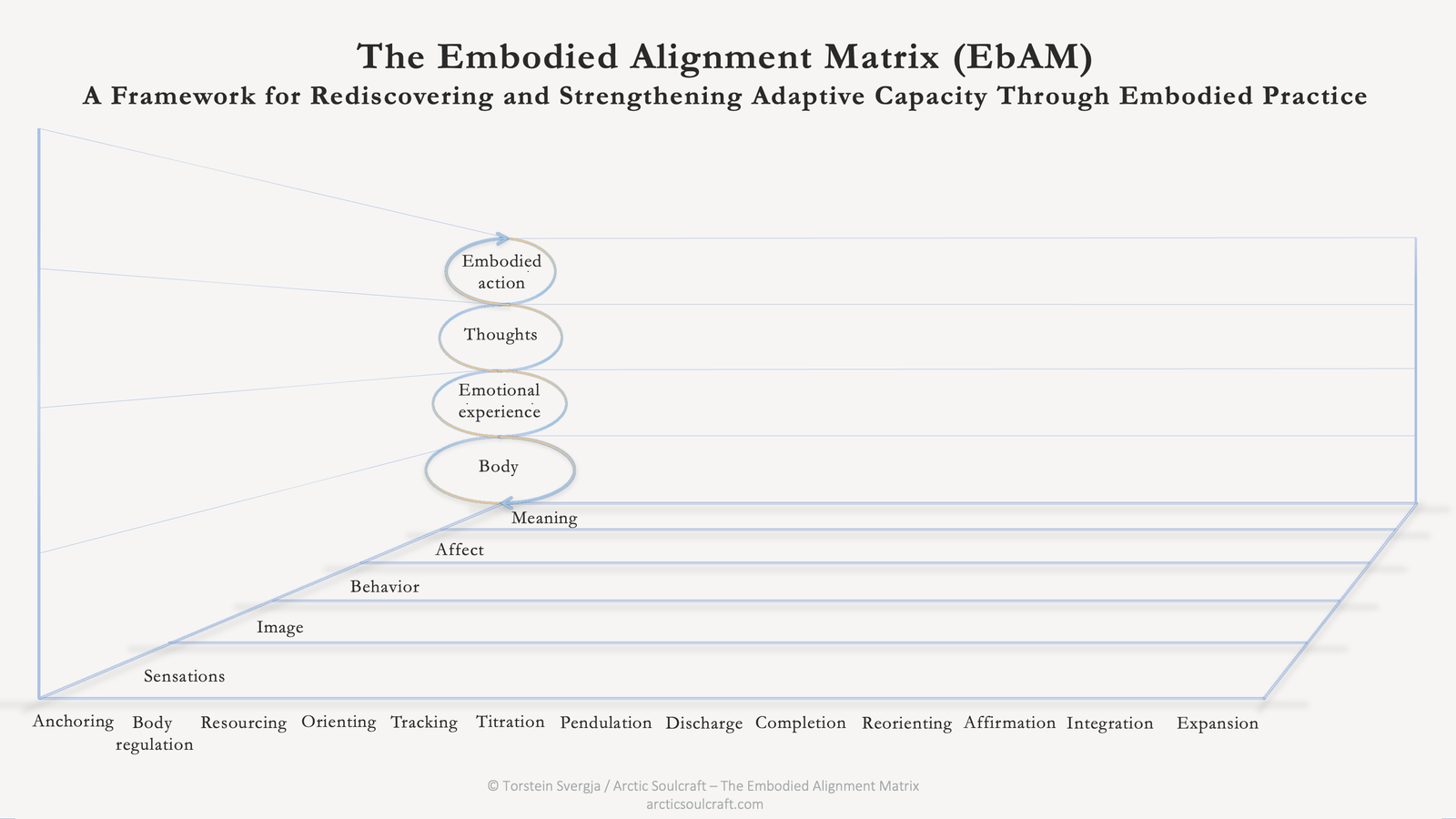
The Embodied Alignment Matrix (EbAM) shows how experience develops along three axes. It describes how capacity is built over time, how experience is organized within the nervous system, and how this is expressed in choices and actions. The model forms the structural framework for the arc of the process in Soulcrafting.
The process axis describes the development of adaptive capacity over time. It moves from basic safety and embodied anchoring, through resourcing, orienting, tracking, titration and pendulation, and further toward discharge, completion and integration.
The anchoring axis shows how experience is distributed across body and nervous system, as sensation, inner images, behavior, affect and meaning. This is why the listening exercises come in pairs. One works through sensation, movement and meaning, the other through inner images, feelings and meaning.
The alignment axis shows how growing capacity in the body opens more room for conscious choice and anchored action.
The sub-processes are the same as in Somatic Experiencing, developed by Peter Levine. The difference lies in content and purpose. Somatic Experiencing is used in therapy to resolve trauma. In Soulcrafting, the work is done with clarified situations that ended long ago, outdoors and with nature as the standpoint, to widen the capacity to hold unease and meet stillness. This keeps the work within self-development.
 Florian Ledoux
Direction
Contact, mobility and orientation
In practice, this involves restoring and strengthening contact, mobility and orientation. The work supports remaining in contact and continuing to orient as challenges increase, and returning to regulated presence as strain subsides.
The maps provide a basis for recognizing what is happening in the moment, and are designed to support the rediscovery of aliveness.